Boring Is the Goal: Why Good Caregiving Depends Less on Heroics and More on Systems
We romanticize a kind of caregiving that can break people, and because we admire it instinctively often without questioning whether it makes sense in the first place. The image of one devoted person holding everything together through effort alone, remembering every medication, managing every appointment, solving every problem as it comes, carrying every loose end because there is no one else to carry it. We call that love, sacrifice, and strength. Sometimes it is all of those things, and sometimes it is also an unstable system resting almost entirely on one exhausted person.
A great deal of suffering in family caregiving comes from trying to manage complexity through improvisation. What begins as helping someone you love can quietly become running a small care system without training, backup, and often without much structure. One person becomes the memory, the advocate, the scheduler, the safety net, the interpreter of symptoms, the emergency plan. That can work for a season, but arrangements built on heroics are fragile by nature. They hold until something gives, and when they give, people often blame themselves instead of questioning the design.
I have come to think that much of what burns caregivers down is not simply the hard parts of illness or aging, but the friction created when ordinary care has no dependable shape. Too many things are held in memory. Too many problems get solved repeatedly instead of solved once, and that strain accumulates until it starts feeling normal.
That is why I keep coming back to an idea that sounds almost too simple, but I believe it reaches deeper than it first appears. Boring is the goal.
Not dull or detached, but in the sense that good systems are often uneventful. The safest care at home frequently looks ordinary because ordinary things have been made reliable. Medications are where they belong. Supplies are where they belong. Transfers happen in familiar ways. The day has rhythm instead of constant reinvention. Fewer things become emergencies because fewer things are being left to chance.
There is a temptation to think effective care should look intense, as though visible strain proves seriousness. I have never found that to be true. Some of the strongest caregivers I have known looked calm, not because they were carrying less, but because they were carrying it through routines that worked. They were not rebuilding the day from scratch every morning. They had simplified repeated problems. They had reduced unnecessary motion. They had made hard things, if not easy, at least steadier.
That is what I mean when I say effective care can look almost lazy from the outside. Not careless. Not passive. Mature. A well-run system often appears quiet precisely because it is doing its work.
That matters because many caregivers assume exhaustion is simply proof they are doing enough. Sometimes exhaustion is evidence that too much depends on effort alone. There is a difference.
One question cuts through that quickly. If the primary caregiver disappeared for two days, what happens to person in need of being cared for?
It is a blunt question, but a practical one. Could someone step in and keep things moving? Is there a routine another person could follow? Or does everything live in one person’s head?
That question gets at something central. Care should not depend on a single point of failure. Yet many home care arrangements do.
This is one reason I believe everyone capable in a household should know at least the basics, even when one person is primary and even when professionals are involved. Shared knowledge creates backup. It catches mistakes early. It lowers panic when something unexpected happens. It protects both the caregiver and the person receiving care. I have come to think of redundancy not as overplanning, but as a form of compassion.
The same goes for simplification, which people often underestimate. Under stress, many people respond by adding more. More tasks, things to remember, or ways to do something. Often the wiser move is subtraction. Reduce the mission. Return to what matters most.
Clean. Dry. Safe.
There is a kind of hard-earned intelligence in lowering the bar when complexity is crushing someone. People hear that phrase and assume it means settling. I mean something else entirely. I mean protecting sustainability. Family caregivers can hold themselves to impossible standards and quietly suffer under them, believing every task should happen at textbook level every day. Real life rarely offers textbook conditions. Sometimes good enough is what preserves tomorrow, because burnout is not simply an emotional state. At some point it affects patience, decision-making, safety, health. People do not like saying that because it sounds severe, but avoiding it does not make it less true. In many cases burnout is a system signaling that something needs redesign.
Often there is more room for redesign than people realize. Tasks can be clustered. Repeated stress points can be simplified. Some burdens can be reduced by removing steps instead of adding effort. A lot of disorder can be avoided through foresight rather than accepted as inevitable. Difficulty does not always have to remain as intense as it feels today. That is not optimism. It is structure.
It’s also where I think families and professionals often have more common ground than they realize. Good care rarely improves by asking people to be more heroic. It improves when care becomes more workable. Most caregiving happens in kitchens, bedrooms, hallways, and long ordinary afternoons where people are trying to keep another human being safe
I believe that a good daily routing for a caregiver is steady, repeatable, and has a rhythm to it. It does not depend on miracles or adrenaline or one person absorbing everything. It depends on simple structures that quietly work. In other words, it is almost boring. I do not mean that lightly. I think there is dignity in boring care. There is mercy in it. There is something deeply humane in care that does not make hard things harder through disorder. Lasting care often looks less like sacrifice and more like systems that can survive ordinary life.
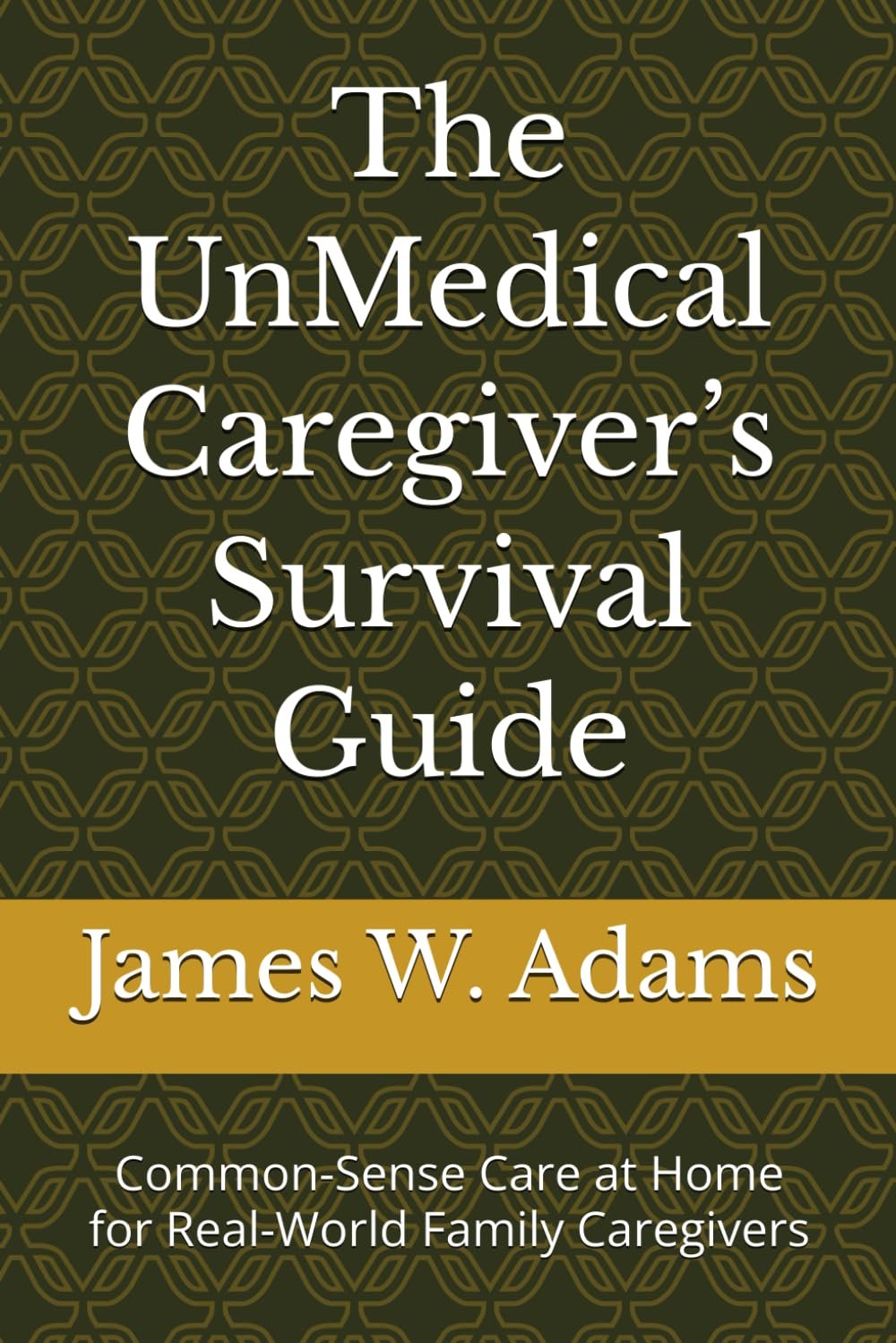
📘 If this way of thinking about care resonates, The UnMedical Caregiver’s Survival Guide expands on these ideas in a practical, real-world way, focused on what caregiving actually looks like at home rather than what it is supposed to look like on paper. Now available on Amazon.
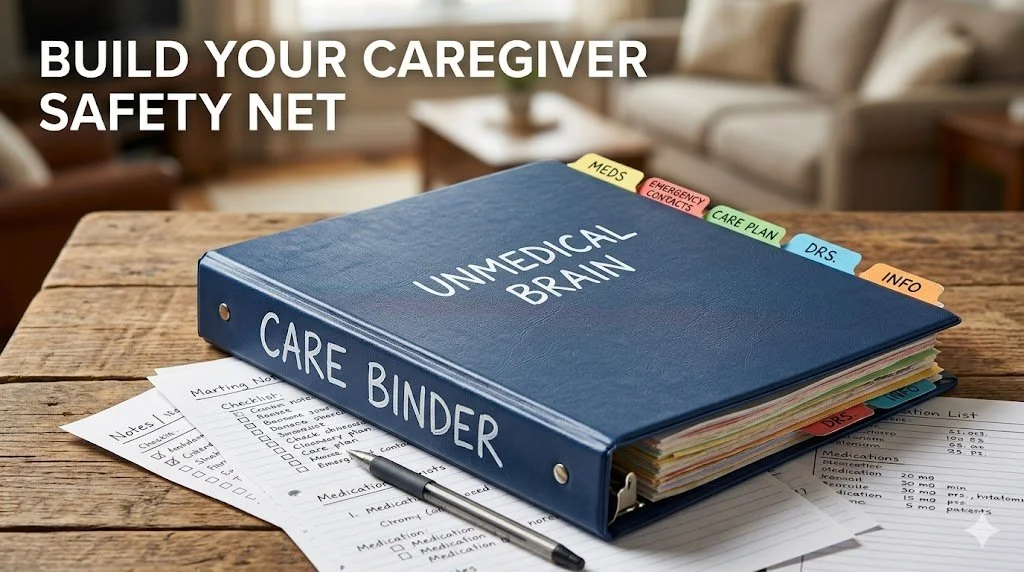
Alongside that, The UnMedical Brain is a home-care binder system designed so care does not depend entirely on memory or one person being present, and the free starter pack can be found here: https://www.unmedicalmedical.com/the-unmedical-brain
I hope you, your family, and your person are happy, healthy, loved, and safe. Unmedical exists to be the bridge between highly trained medical professionals and everyday family caregivers. Our mission is simple: make caregiving clear, practical, and human so you can care with confidence without burning out.
Related Reading
You’re Not a Monster. Caregiving Ate Your Life — Of Course the Dark Thoughts Show Up.
The Hidden Weight of Caregiver Isolation: How to Cope When Help Doesn’t Come
Ask Questions — Then Ask Again: If You Don’t Get It, You Can’t Do It
Disclaimer: I am not writing this from the perspective of a medical professional. The information in this article is for general caregiver support and educational purposes only. It should not be taken as medical advice, diagnosis, or treatment. Always consult a qualified healthcare provider with questions about your loved one’s health or recovery.